Wednesday, May 01, 2013

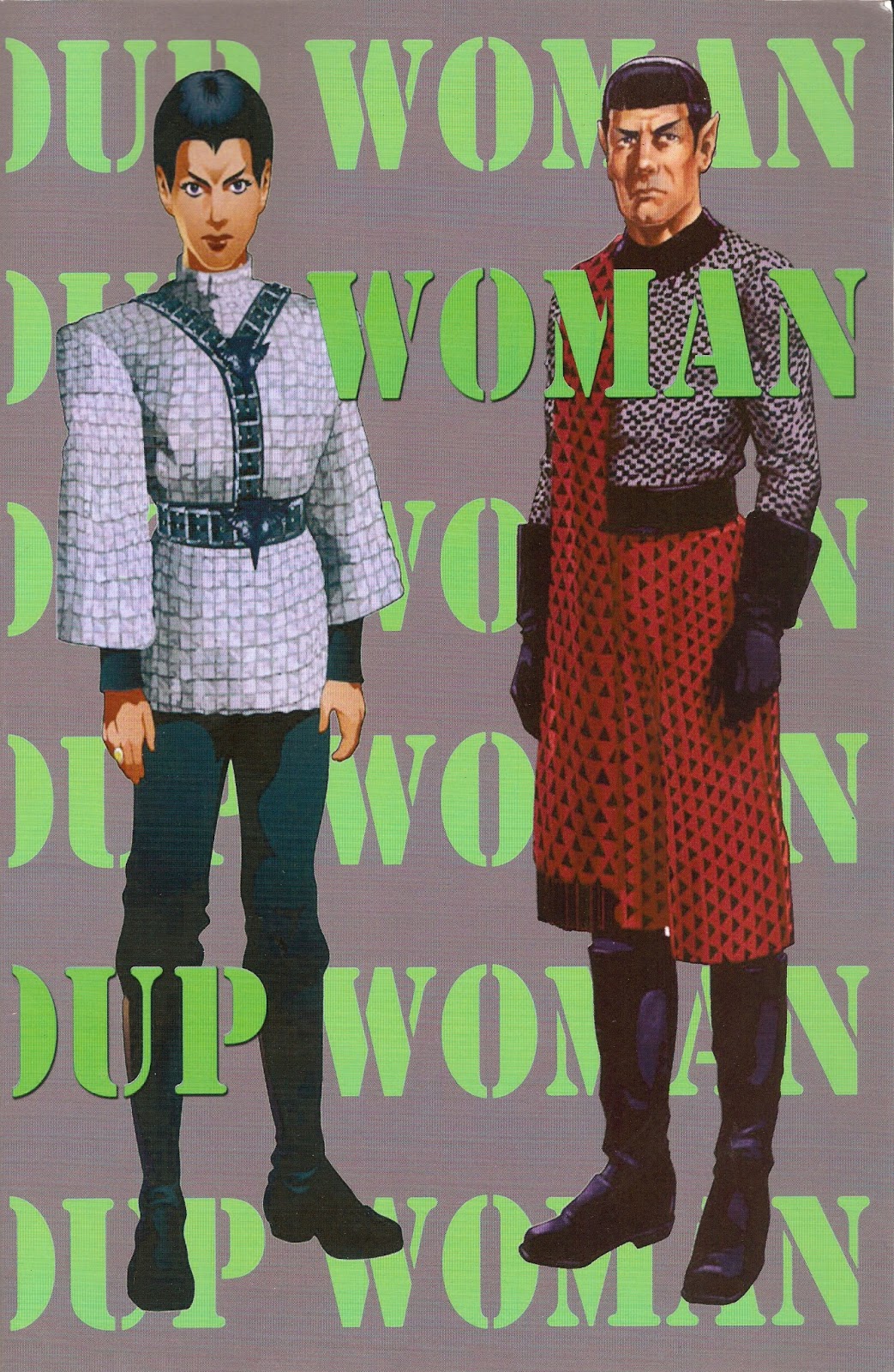
ROMULAN SOUP WOMAN (DAMN THE CAESARS SUSPENDED)


UNEMPLOYMENT + TELEVISION = ROMULAN SOUP WOMAN
UNDEREMPLOYMENT + STREAMING VIDEO = ROMULAN SOUP WOMAN
OVER BUT UNDERPAID EMPLOYMENT = ROMULAN SOUP WOMAN
YOUR MOTHER + MY MOTHER = ROMULAN SOUP WOMAN
DISSIPATING SURPLUS VALUE + HULU = ROMULAN SOUP WOMAN
NETFLIX CALL CENTER BREAK REGULATIONS = ROMULAN SOUP WOMAN
Passing remarks, communiques, lineated critiques, speculative commentaries and inter-ludic disquisitions on science fiction, the culture industry, thermonuklearen terrors and crustaceous justitia from Jo Crot, Benjamin Friedlander, Samuel Solomon, Anne Boyer, Verity Spott, Amaranth Walton, Joe Luna, Caitlin Doherty, Boyd Nielson, Samantha Walton, Pierre Joris, Justin Katko, David Grundy, Peter Manson, Amiri Baraka, Andrew Spragg and Die Zwei Owens.  Texts proceptually appropriated from Douglas Oliver, Neil Pattison, Nikolai Ostrovsky, Buckminster Fuller and James Warhola. Komix by Hiram Kruller. Komix from a North Korean manga primer on political economy. 84 pages.
BOREDOM + GENE RODDENBERRY - TARKOVSKY = ROMULAN SOUP WOMAN
YOUR SISTER + MY SISTER = ROMULAN SOUP WOMAN
MASSIVE OPEN ONLINE COURSES + AUSTERITY = ROMULAN SOUP WOMAN
TARKOVSKY + RON PERLMAN = ROMULAN SOUP WOMAN
TOTAL SURRENDER TO THE CULTURE INDUSTRY = ROMULAN SOUP WOMAN
MEANINGFUL LOVE FOR BIG HOLLYWOOD = ROMULAN SOUP WOMAN
ECOCRITICISM DIVIDED BY COSMOCRITICISM = ROMULAN SOUP WOMAN
VOLUNTARY SUPPLICATION = ROMULAN SOUP WOMAN
OBJECT ORIENTED ONTOLOGY + TENURE = ROMULAN SOUP WOMAN
REPELLING FROM THE ROOF OF THE MoMA = ROMULAN SOUP WOMAN
SUBCONTRACTED DAYLABOR = ROMULAN SOUP WOMAN
EXTREME COUPONING = ROMULAN SOUP WOMAN
THE DEATH OF HUGO CHAVEZ = ROMULAN SOUP WOMAN
MISREMEMBERING MARGARET THATCHER = ROMULAN SOUP WOMAN
KIM JONG UN + KIM JONG IL - SUNSHINE = ROMULAN SOUP WOMAN
PREFERRED CUSTOMER SAVINGS = ROMULAN SOUP WOMAN

Tuesday, February 12, 2013

RECENT AND FORTHCOMING COMPLINE TITLES


In order to bring out forthcoming titles from David Brazil, Jackqueline Frost, Jennifer Scappettone, Leslie Scalapino and others, poet-printer Michael Cross's Oakland-based press C O M P L I N E must sell books. So far as I know the press receives no formal institutional support. Future titles are precariously subsidized by the sale of previous titles or, in the worst instances, funded entirely out of pocket. This would seem in a sense a crippling disadvantage, but for Cross this disadvantage is total advantage and few other presses so inexhaustibly and so consistently (so dependably) synthesize aesthetic and political practices in a manner that so well supplements the contradictory conditions of the present.

Earlier titles: CJ Martin, Two Books; David Brazil, To Romans; Sara Larsen, Merry Hell; Craig Dworkin, The Crystal Text; Eleni Stecopoulos, Daphnephoria; Joan Retallack, The Reinvention of Truth. Barring offset or photocopied interiors, most of these titles are printed on a Heidelberg vacuum press (Cross is the only poet-printer I know capable of throwing such a mechanically enigmatic Leviathan into the service of small press poetry; this alone elevates his practice to the condition of myth.
                        

From 2004-2009 Cross printed and published titles, largely out of Buffalo on a Vandercook 4, through the ATTICUS / FINCH imprint. The titles, many of which would not exist were they not first solicited by Cross, include: Taylor Brady and Rob Halpern, Snow Sensitive Skin (Cross provides the foreword to the 2011 Displaced Press edition); Lisa Jarnot, Iliad XXII (second edition brought out by Bookthug); Myung Mi Kim, River Antes; Patrick F. Durgin, Imitation Poems; John Taggart, Unveiling / Marianne Moore; al-Husayn ibn Ahmad ibn Khalawayh, Names of the Lion (translated by David Larsen); Eli Drabman, Hit the Ground Running; Thom Donovan and Kyle Schlesinger, Mantle; Elizabeth Willis, Meteoric Flowers. This to mention nothing of the countless broadsides, rogue chaplets and chapbooks, announcements and posters printed by Cross across a period that spans nearly a decade.

A recent example: THE FEELING I$ MUTUAL | A LI$T OF OUR FUCKING DEMAND$ (2012), an anthology edited by Sara Wintz that includes responses from Dan Thomas-Glass, David Buuck, Jamie Townsend, Lauren Levin, Kevin Killian, Zack Tuck, Anne Lesley Selcer, Alana Seigel, Alli Warren and others (enthusiastically commented on at HTML Giant, Harriet and elsewhere shortly after it first appeared).
    

Looking now at the scope of this labor — the wide range of names and sheer number of titles built in places as various as Buffalo, Seattle and Oakland — a bibliography annotating the genesis of these publications might be useful (presently there's no way to track the appearance of ATTICUS / FINCH titles other than consulting online library catalogs, none of which offer any meaningful information on the astounding material production of these books). In advance of such a thing:         

Saturday, November 10, 2012

TWO COMPLINE TITLES FROM OAKLAND OUT

Every few weeks a new Compline publication rolls in from Oakland, each arriving like an encrypted communique from the front line of a  protracted cultural assault. Two arrived in one shot some time ago: Thom Donovan's The Hegemon Say and Sara Larsen's Merry Hell, both collaboratively designed and printed by Michael Cross and Stephen Novotny in advance of a 14 September 2012 reading with Suzanne Stein in San Francisco. The publications are outstanding specimens of an approach to book making where the material production of neither print object exceeds or overshadows the writing that occasioned it. At the same time, neither book can be adequately approached without reading them through the bibliographic codes that frame and inflect the writing. We see this most clearly in The Hegemon Say, a book built after Theresa Hak Kyung Cha's Pomegranate Offering (1975). Like Pomegranate Offering, Donovan's Hegemon is a spray-stenciled sack, coarse burlap in this case, with a drawstring at the top and, as with Hak Kyung Cha's piece,  the mouth is everything: "Hand in mouth | Mothers in excess | Recessed like | This shore just moved." In the stanza that appears on the title page (pictured below) "Surfeits," excesses, "like surfaces" flare up, flashing, disclosing their exile, their location beyond the inside of a shifting limit, "This shore just moved." These lines, hand-set in monotype and immaculately printed, appear on smooth granite stock (the stock itself alluding to the granite in Cha's pomegranate), but they are encased in the crudest of materials, spray-stenciled burlap, and this crude exterior at once complements and undercuts the smooth blemish-free interior. A dialectic is at play here, active and irreconcilable, between interior and exterior, the abstract character of the text and the concrete materiality of the print object, and these actively antagonistic spaces of articulation shore up the strength of the poem itself where "History exceeds every | Vision I've ever had."    
Inasmuch as the abstract itself engenders determinate force, this too has a material existence and so there can be no vulgar reduction of such a print object to any kind of tortured opposition between the concrete materiality of the object itself and what the object says with or against this materiality. The saying itself is an inextricable part of the object and its condition. It is the hegemon that says, and it is thus that we come round to a war of position, the struggle of saying. But, as I believe Donovan would agree, such a struggle is not reducible to saying but is a problem of saying enfolded in a much more complex configuration of conditions such that saying alone is not enough. And the contradictions thrown into relief through the print construction of this piece, The Hegemon Say, complements such an understanding.

Likewise for Sara Larsen's Merry Hell, which opens with an epigraph from Rimbaud: "morality is water on the brain." The book is dedicated to "Helen" and "for the women of the Paris Commune | for my friends." Here "author  ity    is spirit, semen, CASH." Dedicated as it is to the women of the Paris Commune, I have wondered at times if this writing is a statement of protest critiquing activist organizations in Oakland, where Larsen is located — I mean, Merry Hell seems much more than a mere indictment of capital and reads instead as a far more interior critique, an internal memo circulated to address a problem among activists within a particular community: "to only crash through     costume lavish sweetbread club officers     un union of femme | is my serious task." Further on the narrator relates: "i hear sirens beyond whatever barricades appear."

Writing from this treacherous distance it's difficult to say one way or another, though it does seem this text emerges out of a fixed location within a regionally specific intellectual and political ecology. Framed by the New York Times as "the Last Refuge of Radical America" back in August, Oakland might very well seem a "merry hell" to politically engaged women writers if activist organizations there now were encumbered by the same problems that generated such a splintered Left through the seventies and eighties. I'm thinking here about the 1981 Left Write Unity Conference in San Francisco organized by Steve Abbott and Bruce Boone. Kaplan Harris commented on the conference a couple years ago in "New Narrative and the Making of Language Writing" (American Literature 81:4), noting that, while the conference aspired to unify a dispersed constellation of radical writers, "the most contentious issue was the role of gays and lesbians in leftist critique." The landscape is unquestionably different now, given to a different set of circumstances and conditions, but Larsen's Merry Hell compels me to wonder if the old fault lines aren't somehow reasserting themselves or if Merry Hell is itself a prophylactic statement against the reemergence of these fault lines within an ebullient community of activist writers. Removed from its local environment, the legibility of such a document is limited at best, but the fact that Compline (the twilight of the workday) so brilliantly registers such moments in print is something to be grateful for. The books are available.

Tuesday, November 06, 2012

ROD SMITH FROM DEED FOR ELECTION DAY

Presumably composed sometime during the hysterically violent, repressive and culturally destructive vigilante stylings of the Bush-Cheney hegemony, Rod Smith's Deed (University of Iowa) arrived in 2007 as a lucid confirmation that Blackwater Security Consulting was not an ideal employer to work for, even if they were the only game in town, i.e. "The Narrative Quiescence": 
yet monochromatic war was no longer satire so much as some
technophobe totem experimenting over the balcony
in the gas he goes to call
& is stirred by —
but managed somehow to boast 
anyway, something about a drinking problem
or a missing arm or an alien culture
but I stopped it there feeling the terms alien & culture extremely personal
& felt the danger, the literal urge
in fact to actually say something about
micromanaged alienation &
the experience of audience participation as portrayed in the
soft porn novels of my own two-teared society. 
Such a poem is enduringly apropos, resonating well beyond the immediate conditions of its making, though the piece that comes to mind now, on election day, is "Ted's Head," a prose meditation on the Mary Tyler Moore Show:
So there's this episode of Mary Tyler Moore where Ted's trying to get a raise & after finagling and shenaniganizing he puts one over on Lou & gets his contract changed to non-exclusive sos he can do commercials which is not cool w/ Lou & the gang because Ted's just a brainless gimp & it hurts the image of the news to have the anchorman selling tomato slicers & dogfood so Lou gets despondent because the contract can't be rescinded but then he gets mad & calls Ted into his office & says, "You're going to stop doing commercials, Ted" & Ted says "why would I do that Lou?" & Lou says "Because if you don't I'll punch your face out" & Ted says "I'll have you arrested" & Lou says "It'll be too late, your face will be broken, you're not gonna get too many commercials with a broken face now are you, Ted?" & Ted buckles under to force & everybody's happy, except Ted but he's so dumb nobody cares & everybody loves it that Lou's not despondent anymore he's back to his brustling chubby loud loveable whiskey-drinking football-loving ways. Now imagine if Ted were Lou, if Ted were the boss. You know how incredibly fucking brainless Ted is, but let's imagine he understands & is willing to use force. That's the situation we're now in as Americans. 

Thursday, October 11, 2012

SAMUEL SOLOMON HIS LIFE OF RILEY

Thinking about Samuel Solomon's Life of Riley (Bad Press 2012) while reading through Yeats's "Introduction," the 1937 prefatory note composed for an edition of his complete works that never appeared, I found myself struck by the following claim: "A poet is justified not by the expression of himself, but by the public he finds or creates; a public made by others ready to his hand if he is a mere popular poet, but a new public, a new form of life, if he is a man of genius." Beyond calling out the extraordinary belatedness of recent critiques of self-expression at all times linked with an irrepressibly bourgeois desire to recuperate genius as an operative concept, this statement from Yeats is fascinating for its attention to the formation of publics. But rather than imagining a public as a social formation that one participates in building with others, we are offered here one of two options: if we are "mere" poets, we can move blindly along with an uninspired herd; or, if we are artists of genius, we can single-handedly construct a new form of life like some sort of megalomaniacal one-size-fits-all vision of good living. There are unquestionably other possibilities, i.e. aligning oneself with a broader, more lateralized collective effort to construct a "form of life," or ways of feeling and grasping, capable of meeting the confluence of demands disposed in the present. Solomon's Life of Riley angles toward such an alignment, each of the poems grounded in a strategic deference that subordinates the narrativized self to a more collective endeavor without surrendering, and arguably by way of, an otherwise self-indulgent lyric excess. We see this most clearly, I think, in the title poem, "Life of Riley," a short run of articulated lineated constructions that bear out, among other things, a generalized critique of the American Left:

each is claiming material conditions
for the analytical framework there won't be proof
of what is really happening if I'm not there
may I still care whether you COME OR NOT 
the real movement of history is also at and has
also been in the dead left which continues as material
force or only irrelevant reaction you would say that
I know you do all the time and then return to what 
we all know so much
why DON'T we just write it down?
we probably do mean the leadership of the most
oppressed and not merely of the oppressed 
workers and that fuckall anxiety about being right
is ours to share is a bad comfort he says
I hate it and love you but isn't it more
to hate the center since we don't all sin the same

On the terrain of organization, as a built thing that cuts from cover to cover, Life of Riley feels uneven,  reading at times like an accidental arrangement or sheaf of poems contingently assembled as a hasty response to an unanticipated emergency. Whether this seeming hastiness is staged or not, the unevenness of their arrangement lends these poems a sense of urgency appropriate to the objects of their attention. Topical concerns run up against more enduring problems, are filtered through them, i.e. "She Drives the Buick" where Queer soldier Bradley Manning's role in the proliferation of classified documents through WikiLeaks is juxtaposed against the problem of Russian pronationalistskiy under Putin:

How do you queer Marxists propagate?
Topical banquets of know-how launched tungsten.
          Bradley Manning or new Russian pronatalism
          forget to be that ugly but don't know how not to
          semi-conduct torture.


Come back to certain names with variations
to indicate the revulsion-complex, so
attraction, coolness, etc. of that person
his famous actions, sense of an unhinging
contingently controls his fame, made
necessary somehow. Then notice how the gay
bitch's verge wilts down into radical queer.


Little Miss Manning's a rich snobby old lady
she threatened to throw a glass of Rosé in my face
but quickly remembered here delicacy and simply
snickered she'd out me on the internet ... pointing
                                                like Maleficent —
(she knows me, she walked with me once upon a dream,
in fact in a childhood nightmare featuring a witch
who was also a wasp, counting children with her
sinister hand, stinging-finger pointed, what could be
more terrifying than counting children well I'm
scared!) — like Maleficent, then, we toss
each other heaps of appropriated shade, I mean,
what kind of man is that. I know you're thinking
this too, and that says most about me. We want
to be Miss Manning and the witch.

The poem is remarkable for its desubjectivizing subordination of lyric interest to an emergent social formation through a lyric mode of address. In a sense, the gesture appears to offer the ground for resubjectification — for a more affirmative and collaboratively built public or social formation. How do queer Marxists propagate? Rob Halpern comes to mind, as do New Narrative predecessors like Bruce Boone and Steve Abbott. And after Hot White Andy, what poem written in English today can deploy the word "tungsten" without immediately alluding to Keston Sutherland? As such, "She Drives the Buick" offers itself as an embodiment of solidarity that sacrifices the subject-oriented center of lyric utterance to a more dispersed and socially oriented desire capable of queering socialist activism and challenging the masculinist underpinnings of a long-since dead New Left that, in many instances, continue to endure. The desire to be, at one and the same time, "Miss Manning and the witch" is an expression of utopian longing but, if this is such an expression, it is one that refuses the crippling expectation of an impossible utopia. Envisioning the desirable — the wanted but not yet obtained or an achievement not yet accomplished — was likewise Yeats's understanding of the task of the poet, but for him this imagining could not be queered and, in his 1937 "Introduction" he even went so far as to imagine queerness itself as the enemy: "I say against all the faggots that it is our first business to paint, or describe, desirable people, places, states of mind." The claim is a hateful one, but against the hateful face value of this statement, perhaps it is the latent queerness in his own work that Yeats shrinks from here and lashes out against, an emergent quality that a poet like Samuel Solomon situates in the present as a necessary condition for any meaningful lyric consideration of social justice.

Tuesday, September 25, 2012

JEFFERSON TOAL HIS ARCOBAT

More than syntax, diction seems all to Jefferson Toal. The syntactic construction of his Arcobat (©_© Press 2012) seems, for the most part, reasonably normative, as does his use of punctuation. The diction is completely out of hand. Syntactic formations are torqued, pressured and at times willfully misshapen, as in the poem's opening line, but the wildness of the poem's diction trumps all: "Sonar go loud heat delocaliser." The line is impacted like incoming wisdom teeth and reads as though a comma was carelessly omitted. But a comma would have slowed it all down, marking a deliberate caesura at a time when the privilege of pause is a luxury wholly unavailable to us. And anything that might seem strange or unusual about the poem is, through its frantic turning, remarkably familiar. The first line again: "Sonar go loud heat delocaliser." The clamor of it, like the moment in "Commission" when Pound writes, "Go out and defy opinion, | Go against the vegetable bondage of the blood." In Arcobat there's no need to call for defiance. Defiance is built into the very diction of the poem, from its opening line onward, such that one is repeatedly blindsided by the poem and relentlessly compelled to feel the violent splendor of a psychotic episode, over and over again. This is nothing so tired as ostranenie, radical defamiliarization, Russian Formalism's bloated old drinking buddy. This is total familiarization, the nerve-rattling hyperfamiliarity and grotesque intimacy of the everyday, the blinding opacities of the everyday inverted and mobilized against the spectacular savagery of the everyday. And the poem moves with a strange galvanizing energy that calls us toward it rather than alienating us from it via, say, some sort of amateur and hopelessly belated misapplication of Brechtian affect:    

Sonar go loud heat delocaliser,
this white nucleic head is ethic; aspic of sweat some
put to flow body lotus, do starglide hit fuser-sight
single deformation of an ashen puma.
Brew several awning batch gasify in aerialist
birth flick, to reattach indigo crew where affected
lot for lot, trembling with white vigour to an end
white collapsing, dribbles of motion from an
anaesthetic mouth. So you gyp a limp fad to glue
new doss to shit, what next. Do group sign, do
arakune subset, do forest, light, bled, yellow,
grill on an optic shin, select first dry image tag
content what is this light punched in, what is this
agitant's pay dirt hyping the cycloid, clutching its
stupid guts like air lyrically denatured, you
headshot that witch digitally sudden. Like
new glass feel like curfew, this
pull back blank chute whiff of anti-codon,
do you outburst thrust while the empties intermix,
they form an arduous breathing queue.
Screen shall flicker does sound.
This is also an agreement behavior, a test miracle. 

If, as Donald Davie maintained over half a century ago in Purity of Diction in English Verse, "the diction of the Romantic poets is extremely impure," then Toal's diction is filthy diction, wondrous for its ability to paradoxically rise to the occasion of Davie's most basic claims concerning purity and diction: poetry not as something that figures language as an unreal reality from which we are at all times alienated but poetry as something that vigilantly alerts us to the perfect commonness of language. Toal redirects our attention to the savage  immediacy of this commonness, a thoroughly intimate but taken-for-granted relation to language that lies dormant in a sort of blind spot until activated by poetry capable of ratcheting up such commonness. Not defamiliarization but total intimacy, state agents already at home in our beds. 

NB: Just now rereading Justin Katko and Mike Wallace-Hadrill on Toal in 2010: "The contingencies of grammar in his verse are plasticised not by the will to distance lyric from speech, but by the will to employ any speech units which might possibly have been: vicious childhood cut-up ploy, hydroponic syntax from the weatherbox of infidels, ham-and-bandage fragments from the sick bay of Anglo-American poetical history, itching phantom glyph discharge on text amputees from a Geocities (RIP) homepage sloughed sideways into perception by the code shell’s dream of the motherboard. Toal’s condensations are set upon the fibre of a fragile intellection, demanding the perpetual retracing of an arching triple backflip into a pre-adolescence affected from the station of unsolicited adulthood (vide 'cosplay')." 

Wednesday, September 12, 2012

DAVID BRAZIL TO ROMANS

Sitting with David Brazil's To Romans (Compline 2012), a slight run of poems composed on a manual typewriter, photocopied and stitched into a stiff cover, the title and name of the author printed in black letter font, presumably monotype. Like seminar notes toward a more thoroughgoing biblical exegesis halted midway by  what  maybe the constraint of time or our collective inability to reconcile an ecclesiastical imagining of love with a desire for social justice.


If the book had a bibliography for further reading I suspect it would feature, among other things, the enormous constellation of texts attending to questions of universality, radical politics, justice and Pauline love (i.e. Alexander Kojève's response to Leo Strauss's On Tyranny, Derrida's Memoirs of the Blind &c, Badiou's St. Paul, Žižek's Monstrosity of Christ, Nancy's De-Enclosure and so forth).    


Oscar Romero comes to mind, the last sermon delivered 24 March 1980, the day of his assassination: "Every country lives its own 'exodus'; today El Salvador is living its own exodus. Today we are passing to our liberation through a desert strewn with bodies and where anguish and pain are devastating us. Many suffer the temptation of those who walked with Moses and wanted to turn back and did not work together. It is the same old story."