Friday, March 31, 2017

Fuck Trump. Until he and the whole of his genus are entirely removed from the sanctuary of political power they presently inhabit, how can this not be the first and most enduring concern of any reasoning US citizen? Fuck Trump and fuck every intellectually underdeveloped cretin associated with that fascist, racist, trans-hating, woman-hating, billionaire rapist. There can be, as Margaret Thatcher so memorably insisted, no alternative. Out or holocaust. For anyone sensitive to instant-by-instant developments across the past year there can be no purchase whatsoever that resides between these two positions. We know what this is. We have known all along. Fuck the fascists.

On the terrain of the poetic, in thinking the adaptability of the poetic to present circumstances, I refer here, for my own part, to the dialog I engaged in with my Boston-based comrade Boyd Nielson some years ago:
And perhaps this is the “principle of autonomy” Prynne refers to when, in the closing pages of his 2011 commentary on George Herbert, he claims: “Poetic form as developed in a specific mode of practice contains somewhere within its specification a certain motive and principle of autonomy, in resistance to instrumentalism; not incompatible with other commitments intrinsic and extrinsic, but if the presiding motive of a poem is to culminate in fully becoming its poetic self, to fulfill the nature proper to its kind, it may become cramped or damaged by shortfall or invasion from alien preoccupations, alien because originating from loyalties not so easily reconciled with the objectives of poetic form.” I find myself a little uncomfortable with Prynne’s usage of autonomy in this passage, am perhaps unable to grasp his precise meaning, but his view of poetic form—of a particular species of poetic form—as something other than a blunt instrument to be recklessly swung like a bat or thrown like a brick in the service of an insurrectionary impulse feels spot on. As a poet with an enduring and fully committed affinity for Marxism, I believe Prynne offers a refreshingly affirmative corrective to activist poets whose abysmally uninspired imaginings of poetry compel them only to paradoxically instrumentalize and deride the productive capacity of poetry, thereby diminishing the affective and intellectual energies latent within the poetic. In any case and at the very least, the desire for revolution—for something other than capitalism—should never be an excuse for bad writing or lazy thinking. Yet whenever the tired question of poetry’s relation to the political emerges the results are too often the same. The poet-qua-activist turns against himself, herself, against poetry, for shame of a grotesquely powerless intellectual privilege which, in the final if not every instance, shamelessly yields to the call of capital in order to preserve itself while at the same time preserving the indispensable illusion of its political integrity through a banal cacophony of impotent protestations predictably slathered in all the prescriptive force and masculinist ferocity of a Calvinist sermon. Is it wrong to expect more—demand more—want more—from ourselves and our comrades alike?         
Fuck the fascists. Although poetry, as a phenomenon determined and mediated by the various industries that typically support it, has patently not been the dominant locus of our attention in recent months, if not years, protest and poetic thought has, and we have engaged to the extent that we can, intellectually and otherwise. We have watched the visibility of our transgender comrades in the US virtually disappear from almost all forms of mainstream media and an attention to their health and well-being surreptitiously replaced by coverage of the repeal and reformation of bathroom laws. Our dear Muslim kin presently live with violent uncertainties that I can, for my own part, barely comprehend. Ditto for our undocumented comrades laboring under conditions few others in the US would be willing to; and likewise for our unemployed, under-employed and over-employed working-class comrades, white and otherwise, given to opioid addiction (we have felt this here in our own families, death and detox, despair and devastation).

Fuck the internet. Fuck Facebook. Fuck Google. Fuck Mark Zuckerberg and Eric Schmidt for selling their end-users out to state and corporate interests. Fuck the creepy neocolonial designs Facebook has on Sub Saharan Africa. Fuck the destabilizing and social engineering capacities of the feeds. Fuck device manufacturers for building surveillance capabilities into most every digital object we bring into our homes and carry on our persons. Fuck the USPS for serving as an instrument of government surveillance. Fuck the New York Times for so clamorously bending whichever way political winds blow. Fuck any university that imagines offering space to fascism and hate as encouraging a diversity of opinion.

Fuck the institutions that serve us for having betrayed us at every turn.

Fuck the right. They will come for us all given the chance. We must know this. North Korea was never a threat. We need to never regard them as such. And to our comrades in Iran, India, Mexico and elsewhere, Marxist and otherwise, we stand in solidarity with you; and to those under siege in Aleppo and Mosul, in Yemen and other locations, you are in our thoughts and you are in our prayers. 

Sunday, August 28, 2016

Josh Stanley, from Romantic Leninist Epic Fragments (2016):


Tuesday, July 26, 2016

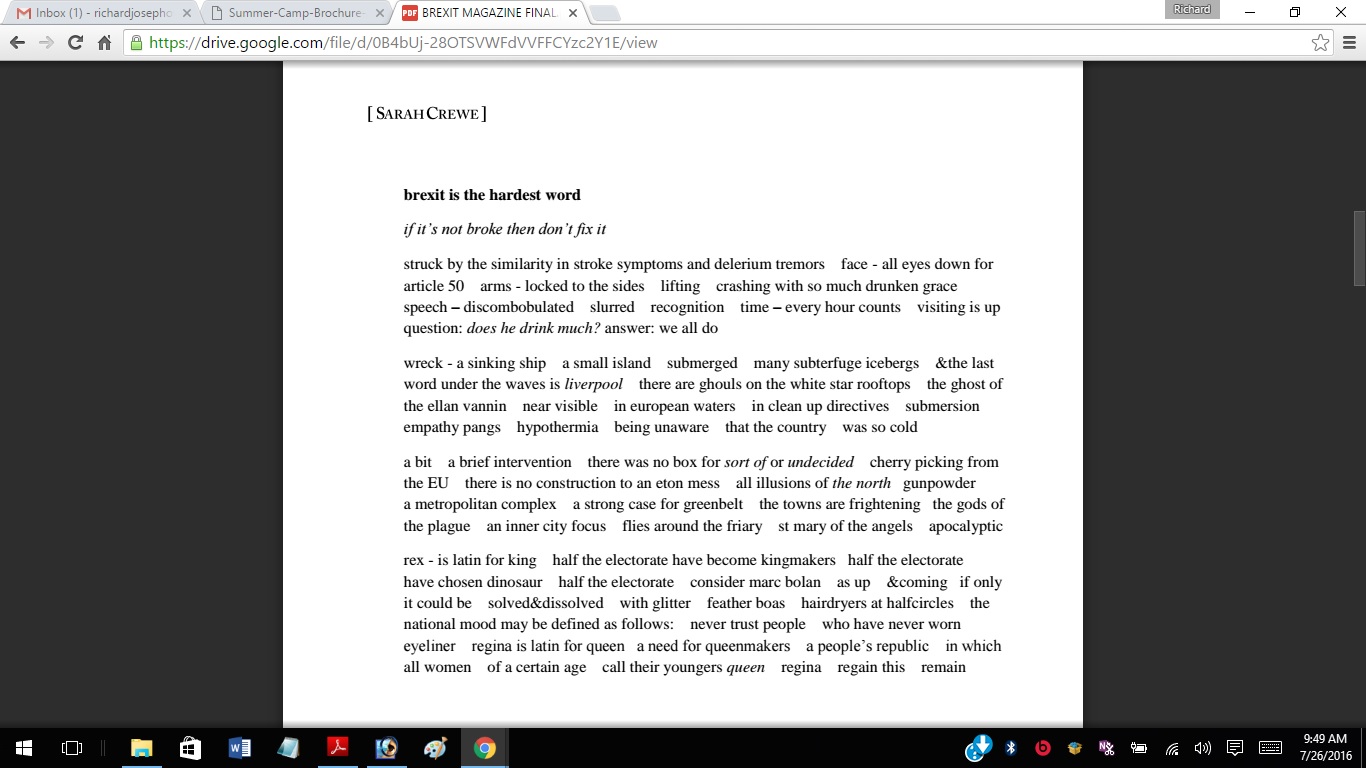
Sarah Crewe, "Brexit is the Hardest Word" in Brexit: Borders Kill (July 2016):

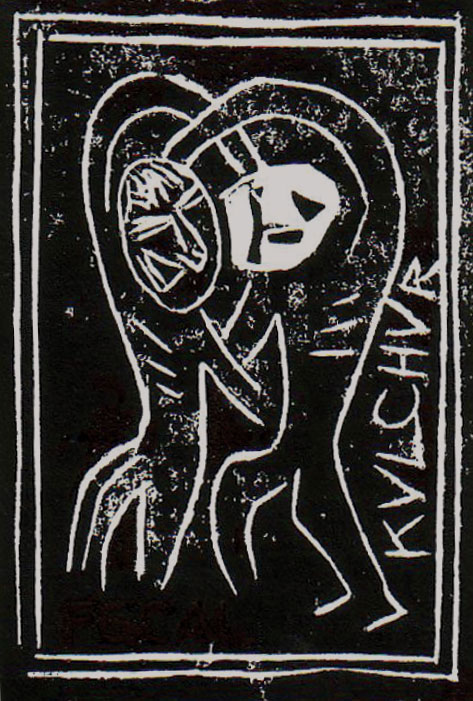
Danny Hayward, from "Morning Note" in Brexit: Borders Kill (July 2016):

Rachel Sills, two poems from Brexit: Borders Kill (July 2016):

Thursday, July 21, 2016

Feliz Lucia Molina, from Crystal Marys (Scary Topiary 2016):

Saturday, July 16, 2016

David Brazil, from Timeless Time (+++ Supersuperette 2015):


Saturday, July 09, 2016

Damn the Caesars / Punch Press stands as an ally and accomplice in express solidarity with BLACK LIVES MATTER. Our prayers and tears, and the intellectual orientation of our daily conversations, have been and will be devoted to the shattering cast of African Americans who suffer and have been lost to police violence, mass incarceration and white supremacist cultural, social and political practices in America. Our love goes out to Philando Castile, Alton Sterling, Tamir Rice, Eric Garner, Sandra Bland, and the staggering number of other African Americans killed, injured and abused by racist institutional force in the US.

Ramsey Orta, the man who filmed the police murder of Eric Garner two years ago this month is preparing to serve four years in prison for possession. Since releasing the film two years ago he has been repeatedly harassed and tormented by police. Ramsey Orta, please accept our gratitude and know that our thoughts and hearts are with you.

The picket sign above, printed shortly after the Charleston massacre by a member of the Southern Maine Workers Center for the 2015 Portland, ME pride parade, has been sitting on the mantle of our inactive fireplace for over a year now. Our young daughter sees it everyday. We discuss it often. We discuss BLACK LIVES MATTER often. We will not turn away. We offer our love, solidarity and support. We are here, we love our African American brothers and sisters, and we pray, and will agitate as we can, for the state-sanctioned murder, incarceration and continued subjugation of black men and women in America to stop immediately. Teach us. 

Friday, June 17, 2016

Thomas Brasch (trans. Lisa Jeschke), from No Prizes #2 (June 2013):

Thursday, June 09, 2016

Verity Spott, from Trans* Manifestos (Shit Valley 2016):


Thursday, May 05, 2016

Forthcoming Labor Day 2016 : S U N D I A L  C O M P L E A T : Tentatively to include: 1) recent and out-of-print Punch Press titles by Sam Walton, Reitha Pattison, and Quenton Baker; 2) new and recent writing from Christina Chalmers, Verity Spott, Thom Donovan, Keston Sutherland, Luke Roberts and others; 3) a substantial aspect of the 2014 volume Materials No. 4 (Economic Ophelia) edited by David Grundy and Lisa Jeschke; 4) the entirety of Basic Middle Finger (Shit Valley 2015) by Justin Katko; 5) an ecumenical bibliography on twenty-first century radical anglophone poetry. 

Saturday, November 14, 2015


M E S S A G E  T O  T H E  U N I V E R S I T Y   ( B A L L A D  I N  F I V E  P A R T S )
THIS BEING A MUSIC NOT A THREAT NOR PRELUDE TO
ANYTHING OTHER THAN SENSE AGAINST THE STORM
************* M O V I N G  P A R T S *************
1. THE FURY (00.00); 2. THE CLINIC (10.37); 3. THE BUILDING (26.04); 4. THE REACHING (52.19); 5. THE LIVING (1.05.17).
BUILT VETERANS DAY 2015.

Wednesday, May 13, 2015

The final two stations to total, against Barnett Newman, fourteen: 1) Pound / Stein; 2) Harp / Altar. Words on the Pound / Stein sheet from the opening lines to The Cantos and Making of Americans. The Crane sheet likewise simple.

Sunday, May 10, 2015

This sheet. A partial curriculum for the study of contemporary radical Anglophone poetry. Unfinished.

Saturday, May 09, 2015

To remember my deeper commitments, and perhaps more specifically to renew enduring affinities and redirect my lesser attentions away from the nascent simmering of smaller ambitions, I turned yesterday afternoon to a file here from 1997 on the NY3: Herman Bell, Nuh Washington, and Jalil Muntaqim, three members of the Black Liberation Army convicted in 1972 for the murder of two New York City police officers a year earlier. Searching then online to see if Bell, Washington or Muntaqim had yet been released, I was shocked to find instead a cheap investigative expose on Herman Bell published 12 March 2015 in the always already disreputable London-based tabloid Daily Mail. Taking clear aim at Bell and no doubt responding obliquely to ongoing fallout from continued police violence against unarmed black men in the US, the inflammatory title of the tabloid article reads somewhat predictably: "EXCLUSIVE: Black Panther double cop killer sues for freedom because he plays the FLUTE."

Mugshot included in Daily Mail expose

From the fall of 1996 through spring 1997—while working with the Paterson Anarchist Collective, the NJ incarnation of the Anarchist Black Cross—I labored toward building an article comparable in scope and intensity to the Daily Mail feature, though the investigative article I imagined aimed at offering a militantly sympathetic view of the NY3: Bell, Washington and Muntaqim. Regretfully, the article never came together as I hoped it would. Repeated requests sent through various Department of Corrections offices here and there were effectively shut down each time and most every attempt I made to coordinate in-prison interviews was blocked. And so, after six or more months of struggling to conduct the interviews and complete the article, which remained nothing more than a small handful of notes coupled with a mass of research files, I shelved the endeavor, at the time only to attend to other matters, but in the end indefinitely.  

Herman Bell | Comstock, NY | 2002

Rather than return to the endeavor with some fantasy of completing it, what I would do here is simply present some of the research and ancillary materials that accumulated around the unfinished article. In conjunction with pamphlets, a newsletter, legal documents and an interview proof, I include here also part of a short but meaningful correspondence with the NY3. The correspondence with Herman Bell was particularly meaningful to me, and he is a figure I am always honored to have met and whose generosity and sensitivity I felt deeply moved by during visits to see him at Great Meadow Correctional Facility in Comstock, NY. I was working somewhat closely with the Paterson Anarchist Collective at the time, visiting political prisoners whenever possible, tabling pamphlets and other literature at ABC-No-Rio and other venues. Comstock was more than three hours from Paterson, and so to abide by the prison's visiting schedule we would depart at 5:00 in the morning, and I recall at least once or twice sleeping in hungover while a horn relentlessly blasted outside my apartment window at 181 Wayne Ave in an effort to jar me from my idiot slumber. But more often than not I would wake when I heard the horn, throw my clothes on and jump into the car waiting for me. And the visits. Comstock where Bell was incarcerated also held other political prisoners and I recall now meeting David Gilbert, a former member of the Weather Underground, during one visit with Bell. Now at Auburn Correctional Facility, David Gilbert was arrested in 1981—along with Marilyn Buck, Judith Alice Clark and others—in connection with the Brinks Bank robbery. In one instance, during one visit to Comstock, after saying so long to Herman Bell, I was introduced to David Gilbert, and I remember it was his soft eyes that most struck me, a care which is not theater written into them. All their eyes struck me this way.

MATERIALS:
1. Untitled pamphlet contextualizing the NY3 conviction.
2. Text of NYT 13 May 1993 article titled 'Ex-Panthers Lose Retrial Motion."
3. 24 Oct 1996 letter on torture to Amnesty International Secretariat from Jalil Muntaquim's attorney.
4. 15 April 1997 letter from Jalil Muntaquim with extensive bio and legal history.
5. 28 April 1997 letter from Herman Bell on regulations regarding in-prison interviews.
6. Proof for pamphlet of 1997 MRR interview with Neil and Matt of the Paterson Anarchist Collective.
7. April 1997 Anarchist Black Cross newsletter.  

NB: The letters from Marilyn Buck and Sundiata Acoli in response to the February interview with the Paterson Anarchist Collective that appears in The Anarchist Black Cross Newsletter first appeared in the March 1997 issue of Maximum Rock-n-Roll. The remarks from Marilyn Buck on music and culture in her letter are instructive.

Thursday, May 07, 2015

Niedecker, her Johnny Appleseed (1945): "When Johnny (Chapman) Appleseed | came to a place he didn't like | he covered it with apple trees. [...] His trees grew while he slept. | Gave to the poor, tho he himself | lived on roots and had no bed."

Wednesday, May 06, 2015

Here details from three sheets currently underway: 1) Steve McCaffery qua Bill Griffiths sheet, with attention to class and dialect; 2) Old Left [no] New Left [no] Now Left, with attention to poetic production; 3. additional detail from the sheet on dialect; 4. sheet on backyards, the whiteness of Lola Ridge perhaps bearing down on the blackness of Gwendolyn Brooks in this formulation, a dialectic to be grappled with much further, residual traces perhaps of something small within me.  Still and so, this is a thinking, a building, a grappling, a learning.

Monday, May 04, 2015

These—three studies—for the Lola Ridge / Gwendolyn Brooks sheet presently under construction, the image built after artist and NFL athlete Ernie Barnes's picture MY MISS AMERICA (1970):

In 1959 Ernie Barnes was drafted by the Baltimore Colts. Barnes also built the picture used in the opening credits of the television series Good Times (1974-79), one of the few shows which, like Sanford and Son (1972-77) and Rosanne (1988-97), sensitively and rigorously attended to issues of class. So the Ridge / Brooks sheet, the object tentatively titled BACK YARDS after two poems, one by each. First Lola Ridge's poem "Back Yards" (1923):
Under the seamless snow
The sky is like a vast ash-pit
Where the buried sun
Rankles in a livid spot.
And then Gwendolyn Brooks's "A Song in the Front Yard" (1963):
I want to go in the backyard now
And maybe down the alley
To where the charity children play.
I want a good time today. 
Good times. Always.  

Friday, May 01, 2015

Mayday. Earlier anticipating it. Today celebrating it. The sheets below looking toward Mayday in the largest sense. STATIONS—these after Andrew Rippeon, his own stations within Priest, an endeavor I am presently working with and looking forward to bringing out across the coming months. Duncan and derivation, that the labor of our friends can stand as models. So the stations in Priest, the book split into three sections that repeat, so then a run of permutations, and "Stations" specifically, apart from the poems in "Priest" and "Flights," the other two recurring sections in the book, these stations break away from lineation, from the burden of the broken line, and break instead into a liberatory prose which is neither prose as such nor a longer line but something unto itself. And so I learn from this, from these stations, and I build my own.


And an open Mayday letter to Richard Parker, another poet-critic-printer, his the Crater Press and he inclined to imagine all of the varied activities he is engaged in as reading. And I for my own part aspire to include the parts of this object called me such that what Parker might call reading I see as a seeing, a hearing, a thinking. In the end this is perhaps no more than a thinking sometimes called feeling. So the canvases, these sheets and no name suits as it ought to and thus too these are leaves, pages, shrouds whose building I regard as worship, this from thinking David Brazil, CJ Martin, Shaker visual poets, others—and in this sense these sheets in their building disclose themselves as maps or a private curriculum at all times unfolding.

And also and perhaps mostly I take these sheets as an editing in the simplest sense, an editing as a listening and a seeing and a thinking. But they are inscriptions. David Jones, Stephen Rodefer, Blake, Dickinson, Sean Bonney, Bill Griffiths, Bob Cobbing, Dom Sylvester Houedard, Finlay, Francis Crot, Alan Halsey, John Furnival, Tom Leonard, and too great a number of others to list here. In concert with these models, I believe these sheets are also informed by the inscriptions on deer and buffalo hides at San Miguel Chapel in Santa Fe, as I understand it the first Catholic church in what is today the US, est. c1610. Franciscans built the hides c1630 so that they might serve as learning aids, a biblia pauperum, for Pueblo peoples. These like Eric Gill's Stations of the Cross relief work at Westminster Abbey. And despite their social function, when I first encountered these hides in the smallness and simplicity of San Miguel however many years ago I found myself moved. So too these sheets, alpha and omega, from swaddling sheet to winding sheet, these. This is not art. This is a thinking:

Whitman sheet:

Sheets primed on shed floor:

Prynne sheet:

Sheets in  process on shed floor:

Baraka sheet:
Final image: Portrait of Rosa Luxemburg—to celebrate—while all else—Baltimore—for all this.

Once the fourteen sheets are complete a catalog of the stations will be printed and distributed. 

Sunday, April 26, 2015

Baltimore. Freddie Gray. Ferguson. Michael Brown. North Charleston. Walter Scott. Leon the Poet (Baltimore): "We do not speak the same language. We forgot how to speak in English and learned how to speak in tongues. You can hear the sound of a beating drum whenever we open our mouths."

This back to Amadou Diallo and to Rodney King and to lynching generally—this white American pastime—James Chaney in 1964—Laura Nelson in 1911—George Meadows in 1889—others—thousands of others—this holocaust. So to remember, and to feel through this remembering, the number of African American men and women lynched between 1865 and WWII: 40,000.


Amiri Baraka (1999): "Word. Music. Dun Dun mean Drum Speaks. Talking drum. Music must speak from the word. Whole word—Sound, syllable, rhythm, content, forming, tempo, meter, cadence." And again Baraka:
 
Drum and Africa     (Dig, Pygmies had neither DRUM nor GOD!
                                 Very Old Folk)
Drum and Europe   (Why the European essential marginalization of
                                 Drum .... Aesthetic or Political?)

And here Baraka as Leroi Jones, Blues People (1963): "The endlessly repeated line of the shout or holler might also have been due to the relative paucity of American words the average field Negro possessed, the rhyme line being much more difficult to supply because of the actual limitation singing in American imposed."

And, in the same year, the essay "Expressive Language" (1963): "And it follows, of course, that slavery would have been an even stranger phenomenon had the Africans spoken English when they first got here. It would have complicated things. Very soon after the first generations of Afro-Americans mastered this language, they invented white people called Abolitionists." For my own part, I would gladly be one of these invented white people.
EARLIER POSTS